DLT, DND and TRAI: What’s Legal for AI Outbound Calls in India (2026)
AI does not change the rulebook. A call placed by a voice agent is a commercial call like any other, and TRAI’s February 2025 amendment made that rulebook a great deal stricter. Here is what it actually says, read from the regulation itself, and what it means for anyone running AI outbound campaigns.
The short answer
- 140series for promotional calls, any sector
- 1600series for BFSI and government service calls
- 5 in 10 dayscomplaints that trigger suspension
- 1 yeardisconnection for a repeat violation
AI outbound calling is legal in India. Nothing in the TRAI regulations reviewed for this article prohibits a machine from placing or conducting a call. What is regulated is commercial communication, and an AI call that sells, reminds, confirms or collects is commercial communication.
That means four obligations apply whether a human or an agent is speaking: register as a sender with a telecom operator, call from the designated number series rather than an ordinary 10-digit number, respect the recipient’s DND preferences unless you hold their explicit consent, and tell your operator in advance that you use auto-dialers or robo-calls. Get those wrong and the penalty is not a fine on you — it is the disconnection of every telecom resource you have.
The rulebook: TCCCPR 2018 and the 2025 amendment
Commercial calls and messages in India are governed by the Telecom Commercial Communications Customer Preference Regulations, 2018 (TCCCPR), issued by TRAI on 19 July 2018. They introduced the blockchain-based Distributed Ledger Technology (DLT) system that operators use to record who is allowed to send commercial communication, what they are allowed to send, and what each customer has agreed to receive.
On 12 February 2025 TRAI announced the TCCCPR (Second Amendment) Regulations, 2025. Per the gazette text, most provisions came into force thirty days after publication in the Official Gazette, and a handful sixty days after. The amendment is the one that matters for AI calling, because it targets exactly the patterns automated outbound produces: high volumes from ordinary numbers, robo-calls, and senders who treat one past consent as permanent.
The regulations bind telecom operators (“access providers”) directly, and operators pass the obligations on to senders through a legally binding agreement that the amendment makes mandatory. In practice, the operator is who enforces these rules on you.
Promotional, service or transactional: which is your call?
Everything else follows from classification, because each category has a different number series, a different consent standard and a different relationship with DND. The 2025 amendment redrew the lines.
| Category | What it covers | Consent | Blocked by DND? |
|---|---|---|---|
| Transactional | A response to a customer-initiated transaction within thirty minutes of it — OTPs, transaction alerts and confirmations, refund information | Not required | No |
| Service (inferred consent) | Information to an existing customer about a product or service they use — warranty, recalls, safety, balance alerts, delivery information | Inferred, valid for the duration of the contract | No |
| Service (explicit consent) | Calls to facilitate or complete an ongoing purchase | Explicit, valid for seven days | Only under FULLY BLOCK |
| Promotional | Any call containing promotional material or advertising, including to prospective customers | Preference-based, or explicit digital consent | Yes, unless explicit consent is held |
| Government | Communication by government entities | Not required | No |
Two rules that catch AI campaigns
Mixed content becomes promotional. The amended definition says that if promotional content is mixed with any type of commercial voice call, the whole call is treated as promotional. An AI agent that confirms a delivery and then mentions this week’s offer has turned a service call into a promotional one — with all the DND and number-series consequences that follow.
Thirty minutes is the transactional window. TRAI’s explanatory memorandum states that messages sent outside that window, such as delivery notifications or flight rescheduling, are service communication, not transactional. A COD confirmation call placed hours after the order is placed is therefore a service call, not a transactional one.
140 and 1600: the number-series rules
The 2025 amendment requires operators to ensure that commercial communication on their networks uses only registered headers or numbers from the special series assigned for commercial communication. TRAI’s press release describes this as restricting senders from using normal 10-digit numbers for telemarketing.
| Series | Used for | Who | Filtering |
|---|---|---|---|
| 140xx | Promotional calls | Entities of any sector, registered under TCCCPR | May be blocked only through the customer’s DND preferences |
| 1600xx | Service and transactional calls | Entities regulated by RBI, SEBI, IRDAI and PFRDA to existing customers; government-to-citizen | No tagging, blocking or filtering permitted |
On 10 July 2026 TRAI issued a clarification after press reports misdescribed these series. It confirmed both allocations above and added that call-management apps may not tag or filter 140 calls except through DND blocking, because tagging could mislead a customer who has chosen to allow calls from that sector.
The practical upshot for AI campaigns is simple: an agent dialling out of a pool of ordinary mobile or SIP numbers to people who have not engaged with you is exactly the pattern the 2025 amendment was written to shut down. At a meeting of the Joint Committee of Regulators on 27 August 2024, TRAI named businesses using PRI/SIP lines for commercial calls as a problem to be migrated to the 140 series.
DLT registration: what you register
DLT is the shared ledger the operators run. Several registers sit on it, and a sender of commercial communication appears in more than one.
| Register | Holds | Why it matters for calling |
|---|---|---|
| Entity register | Registered senders and telemarketers | Unregistered senders are treated as sending UCC |
| Header register | Message headers and their owners | Mainly SMS; headers now carry -P, -S, -T or -G suffixes |
| Content template register | Approved message content | Promotional and transactional templates |
| Consent template register | The wording used to seek consent | Needed to collect explicit consent |
| Consent register | Consents customers have given | What lets a promotional call bypass DND |
| Preference register | Each customer’s DND choices | Scrubbed before a promotional call is delivered |
The 2025 amendment tightened registration itself. Senders and telemarketers must undergo physical verification, biometric authentication and unique mobile-number linking. Operators may ask senders for a security deposit that can be forfeited for violations. And the number of intermediaries between the principal entity (the brand) and the telemarketer is limited so that every call can be traced back to whoever originated it.
Declare your auto-dialer
New regulation 4 is short and directly relevant: every sender must notify its originating operator, in advance and in writing, about the use of auto-dialers or robo-calls and the intended objective of those calls. TRAI’s memorandum says promotional robo-calls should use 140-series numbers only, and service or transactional ones 1600 or another series allotted for the purpose. An AI voice agent placing calls from a list comfortably meets the 2018 definition of an auto-dialer call — a call initiated automatically by equipment to stored numbers — so treat this notice as required.
DND: the preference categories you scrub against
Customers register preferences by calling or texting 1909, by USSD, or through the TRAI DND app. After the 2025 amendment the options are:
| Option | What it blocks | USSD |
|---|---|---|
| 0 — FULLY BLOCK | All promotional communication and service communication that needs explicit consent | *1909*0# |
| 50 — BLOCK PROMO | All promotional communication; service, transactional and government still arrive | *1909*50# |
| 1 | Banking, insurance, financial products, credit cards | *1909*1# |
| 2 | Real estate | *1909*2# |
| 3 | Education | *1909*3# |
| 4 | Health | *1909*4# |
| 5 | Consumer goods and automobiles | *1909*5# |
| 6 | Communication, broadcasting, entertainment, IT | *1909*6# |
| 7 | Tourism and leisure | *1909*7# |
| 8 | Food and beverages | *1909*8# |
Customers cannot opt out of transactional calls, service calls based on inferred consent, or government communication — TRAI’s reasoning is that blocking them could cost the customer important information. The 2018 regulations also let customers choose time bands and day types in which they accept commercial communication.
Consent: how long it lasts and how it ends
The 2025 amendment’s biggest practical change is that consent now expires. The old habit of treating one form-fill as permanent permission is over.
| Rule | What the regulation says |
|---|---|
| Explicit consent for an ongoing transaction | Valid for seven days, or as TRAI directs |
| Inferred consent (existing customer) | Valid for the duration or discharge of the contract; after that, no service calls without explicit consent |
| Explicit digital consent for promotions | Delivers promotional calls regardless of DND preferences |
| Where consent is sought | Consent-seeking messages go out from short code 127xxx via the operators’ Digital Consent Acquisition (DCA) system |
| After an opt-out | The sender may not seek that customer’s consent again for ninety days; the customer may opt back in at any time |
| Opt-out in promotions | Every promotional message must carry an opt-out mechanism in the same message |
For voice, the lesson is that consent has to be something you can produce on demand, dated, and scoped to what you are calling about. A consent collected in January for a delivery is not consent in March for a sale.
Calling hours
We did not find a fixed statutory calling-hour window for commercial calls in the TCCCPR 2018 text or the 2025 amendment. What the regulations provide instead is customer choice: the preference register records the time bands and day types in which each customer accepts commercial communication, in slots from 00:00–06:00 through to 21:00–24:00.
That makes timing a scrubbing problem rather than a clock problem — a call inside a band the customer has blocked is a call against their registered preference. In practice most businesses also set conservative daytime windows of their own, because calls at unsociable hours are the ones that get reported. If you believe a sector-specific rule applies to you (lending and collections are regulated separately by RBI), check it with the relevant regulator; it is outside the scope of this article.
Complaints and penalties
Under TCCCPR the penalty for a sender is operational, not financial: you lose your phone lines. The 2025 amendment made the trigger faster and the consequence broader.
| Before | After February 2025 | |
|---|---|---|
| Window to complain | 3 days | 7 days |
| Action trigger | 10 complaints in 7 days | 5 complaints from unique recipients in 10 days |
| Action against unregistered senders | 30 days | 5 days |
| First violation | — | All outgoing telecom resources, including PRI/SIP trunks, barred for 15 days across operators |
| Repeat violation | — | All telecom resources disconnected for 1 year and sender blacklisted |
Two further details matter for AI campaigns. A customer no longer has to register a DND preference before complaining about an unregistered sender. And any call made to deceive or attempt to deceive the recipient is now classified as UCC, so an agent that misrepresents who is calling exposes the sender to the same disconnection process.
Operators also carry graded financial disincentives of ₹2 lakh, ₹5 lakh and ₹10 lakh per instance for misreporting UCC counts, which is why they enforce these rules on senders firmly. They are further required to watch for spam patterns — unusually high call volumes, short call durations and low incoming-to-outgoing ratios. A badly tuned AI campaign that dials thousands of numbers and hangs up quickly looks exactly like that.
Do AI calls have to be disclosed as AI?
We did not find a TRAI regulation or direction requiring a caller to tell the recipient that they are speaking to an AI. What the 2025 amendment does require is disclosure to the operator: advance written notice of auto-dialer or robo-call use and its objective, as covered above.
The absence of a rule is not a reason to hide it. The “deceive or attempt to deceive” limb of the UCC definition means an agent that pretends to be a named human employee, or misstates who is calling, creates real risk. Identifying the business and the purpose of the call at the start is the defensible default.
The DPDP Act angle
TCCCPR governs the telecom channel. The Digital Personal Data Protection Act, 2023 governs the personal data behind it — the phone numbers, names, order details and call recordings your AI campaign runs on. Parliament enacted it on 11 August 2023, and the DPDP Rules were notified on 14 November 2025 with an eighteen-month phased compliance period.
Section 6(1) of the Act requires consent to be “free, specific, informed, unconditional and unambiguous with a clear affirmative action”, limited to the data necessary for the specified purpose. Section 6(4) gives the person the right to withdraw consent at any time, “with the ease of doing so being comparable to the ease with which such consent was given”.
For outbound calling that means two consents in two systems. TCCCPR asks whether the customer agreed to receive this kind of call; DPDP asks whether you may process their data for this purpose at all. A purchased or scraped list fails both. The Rules also require a standalone, clearly worded consent notice stating the specific purpose, and the Act’s penalties run up to ₹250 crore for failing to maintain reasonable security safeguards and up to ₹50 crore for other violations by a data fiduciary.
Compliance checklist for AI outbound campaigns
Work through this before the first dial. Every item maps to a rule quoted above.
1. Register as a sender with your operator’s DLT platform and complete verification.
2. Classify each campaign — promotional, service or transactional — and keep promotional content out of service calls entirely.
3. Use the designated series: 140 for promotional calls; confirm with your operator which resource your service calls must use.
4. Notify your operator in writing that you use an auto-dialer or robo-calls, and for what purpose.
5. Scrub every promotional list against DND preferences, including time bands, unless you hold explicit digital consent.
6. Record consent with a date and scope, and expire it: seven days for explicit transaction consent, end of contract for inferred consent.
7. Honour opt-outs immediately, across every number you call from, and do not ask again for ninety days.
8. Have the agent identify the business and the purpose of the call; never impersonate a person or another company.
9. Watch your own complaint rate and call patterns — five complaints in ten days is the line.
10. Map the personal data you use to a DPDP purpose and consent, and make withdrawal as easy as sign-up.
What Adya enforces, and what it does not
Adya’s campaigns run every send through one gate. Opt-outs are removed when the audience is built and re-checked immediately before each send; a customer who sends STOP to one of your numbers is suppressed on all of them, across every campaign. Quiet hours hold calls to 10:00–19:00 and messages to 09:00–21:00, queued rather than dropped. You state the lawful basis before launch, and a consent audit trail records who attested, when and for how many people.
What Adya does not do is make you compliant with TCCCPR on your behalf. Sender registration, the number series you call from, DND scrubbing against the operators’ register and the auto-dialer notice sit with you as the business making the calls — our acceptable use policy says so plainly. How we handle the data itself is on our security page.
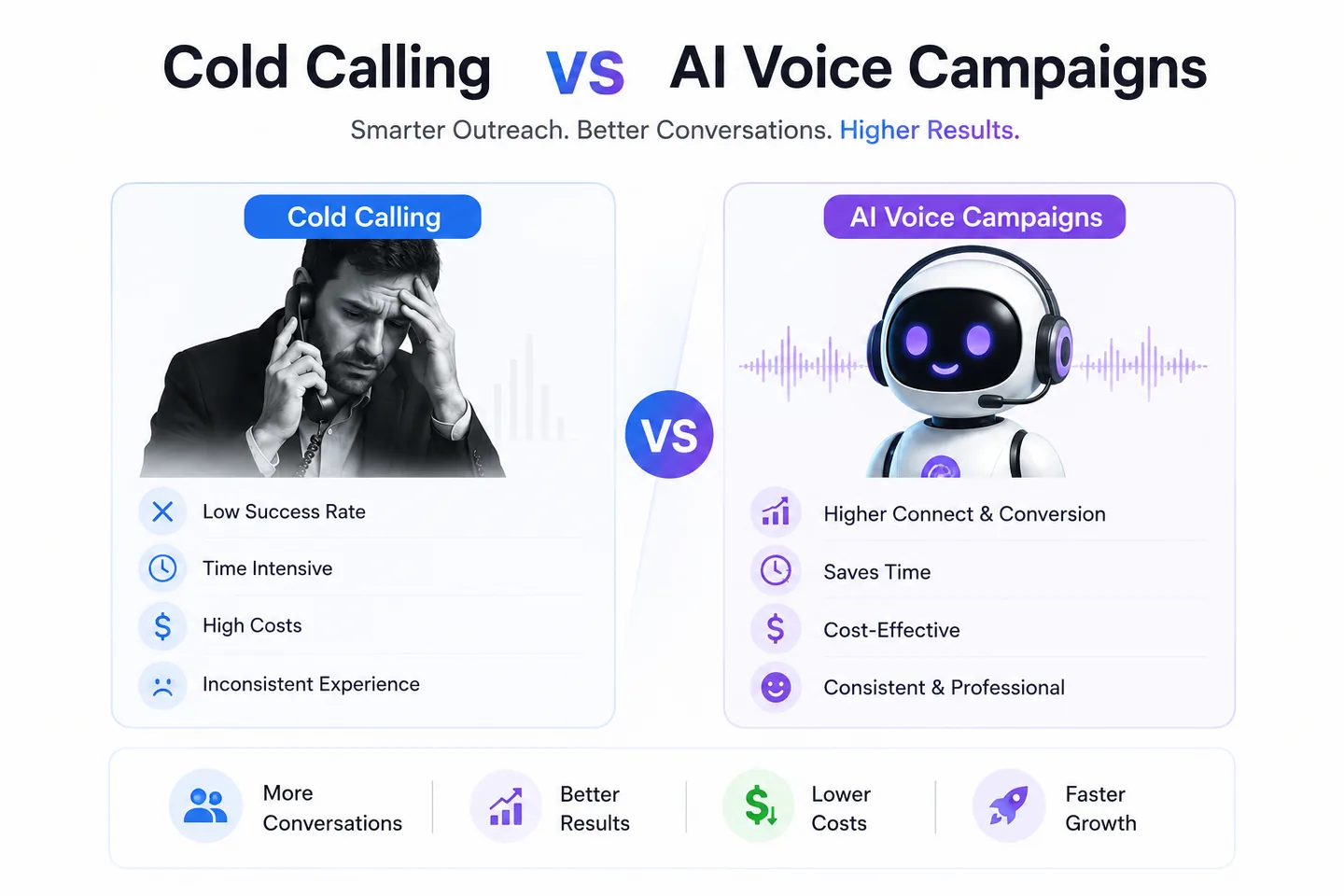
If you are weighing AI calling against a traditional telecalling team, the regulatory burden is the same for both; the difference is in cost and consistency, which we compared in cold calling vs AI voice campaigns.
Frequently asked questions
Yes. No TRAI regulation we reviewed bans AI or automated voice calls. What the Telecom Commercial Communications Customer Preference Regulations (TCCCPR) 2018, as amended in February 2025, regulate is commercial calling: the sender must be registered with a telecom operator, promotional calls must come from the 140 number series and respect the recipient's DND preferences or explicit consent, and senders must tell their operator in advance that they use auto-dialers or robo-calls.
The 140 series is for promotional calls by entities in any sector. The 1600 series is mandated for service and transactional calls by entities regulated by RBI, SEBI, IRDAI and PFRDA to their existing customers, and by government entities. TRAI clarified on 10 July 2026 that calls from 1600 numbers may not be tagged, blocked or filtered, and calls from 140 numbers may only be blocked through the recipient's DND preferences.
If the calls are commercial communication, yes: the 2025 amendment says no sender who is not registered with an access provider may make commercial communication, and all telecom resources of an unregistered sender may be suspended or disconnected. Registration happens with your telecom operator's DLT platform; the amendment adds physical verification, biometric authentication and mobile-number linking for senders and telemarketers.
For promotional calls, only if you hold the recipient's explicit digital consent, recorded through the operators' Digital Consent Acquisition system. Otherwise a promotional call is delivered only to subscribers who have not blocked that category. Transactional calls and service calls based on inferred consent are not blocked by DND preferences.
Under the 2025 amendment, complaints from five or more unique recipients within ten days trigger suspension of the sender's outgoing services and an investigation. A first confirmed violation bars all the sender's telecom resources, including PRI/SIP trunks, for fifteen days across all operators. A second violation disconnects all of them for one year and blacklists the sender.
Sources
- 1.TRAI — TCCCPR (Second Amendment) Regulations, 2025, gazette text
- 2.TRAI — Press Release 11/2025: TRAI strengthens consumer protection with amendments to TCCCPR, 2018 (12 February 2025)
- 3.TRAI — Press Release 91/2026: clarifications on the 1600 and 140 series (10 July 2026)
- 4.TRAI — Telecom Commercial Communications Customer Preference Regulations, 2018
- 5.TRAI — Press Release 58/2024: Joint Committee of Regulators meeting (27 August 2024)
- 6.MeitY — Digital Personal Data Protection Act, 2023
- 7.PIB — DPDP Rules, 2025 notified (17 November 2025)